
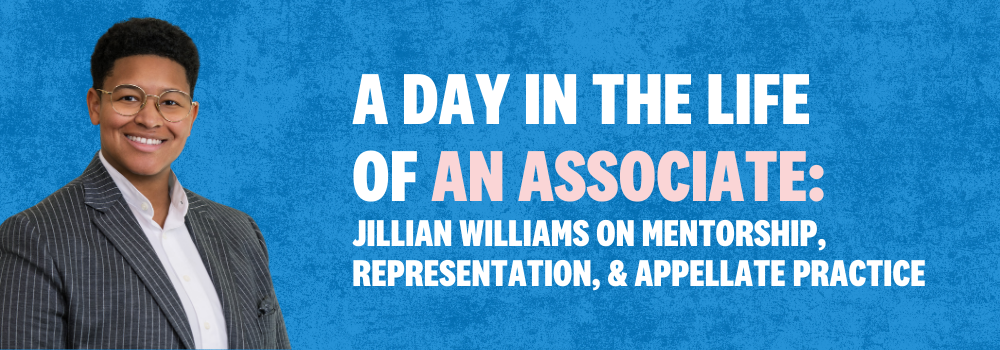
A Day in the Life of an Associate: Jillian Williams on Mentorship, Representation, and Appellate Practice
In honor of Black History Month, we celebrate Jillian Williams, an Appellate & Supreme Court associate at Arnold & Porter Kaye Scholer LLP whose journey into appellate practice reflects the transformative power of mentorship and representation. As a Black professional navigating legal spaces, Jillian brings vital perspectives to their work while actively opening doors for the next generation of appellate leaders.
We asked Jillian about their experience as an associate in appellate practice—from daily collaboration to the responsibility of representation.
Walk us through what a typical day or week looks like in your role.
It depends. If I’m working on something court-facing—like a motion or brief—I might spend much of the week researching, writing, or revising. As we get closer to a finalized draft, I may shift to incorporating client comments and responding to their questions before preparing the draft for filing.
At other times, I’m asked to think through a discrete issue for a client and summarize our conclusions in an email or a longer memo. Some weeks, I work on developing and coordinating amicus strategy for a case—reaching out to faculty or other interest groups about filing an amicus brief on our client’s behalf. Or I may also review a document before it goes to an agency. On quieter days, I try to listen to oral arguments or read the Court’s opinions as they’re released. Often, it’s a mix of all of the above.
How often do you collaborate with colleagues versus working independently?
I’d say it’s about 50-50. I can only speak from my experience at Arnold & Porter, but the firm is very collaborative—both within teams and across offices and practice groups. As a mid-level associate, I spend a lot of time going back and forth between more junior and more senior attorneys.
Depending on the size of the team, you may be responsible for a substantial section, or even the full first draft, of a brief. In those instances, you might spend more time working independently to research, outline, and refine your section before combining it with others’ work or brainstorming next steps as a group.

What's your process for getting feedback from partners and/or supervisors?
I’ve found that one of the best ways to learn—without even having to ask—is to compare each new version of a draft to the one you submitted and see what changed. I was given that advice as a first year, and it’s helped me to get a steady stream of passive feedback. Beyond that, the most direct way to get feedback is simply to ask—ideally after the assignment or matter has wrapped up and people have more time to reflect on your work. Another approach is to flag specific concerns in real time. For example, if I’m not fully satisfied with how I’ve written or resolved an issue, I might send the draft along and say: “I drafted this section this way but also considered including ‘X’—would appreciate your thoughts on how it reads,” and provide some alternatives.
I think those three approaches together create multiple avenues for feedback—both at a granular level and from a broader, big-picture perspective.
If you could go back to when you first started as an appellate associate, what advice would you give yourself?
I would tell first-year me to “back myself” more. Sometimes we forget about all the things we’ve learned and accomplished just to get to this moment, or we feel like we have to show up to a matter and already know everything—and that’s just not true. You’re here because of all the things you’ve achieved and because others believe in your ability to grow and to produce excellent work at a high level. So, start with the first step and trust that you have the tools and the know-how to do it well.
What does it mean to you to be a Black professional in appellate practice?
It’s a privilege, certainly, but that privilege also comes with responsibility. I often find that in certain rooms, I may be one of the only—or the only—person who looks like me or shares my background. That can feel heavy at times, and I hope we’ll continue to see the kind of change that ultimately lightens that load.
I remember being in law school when many of us first became interested in appellate work but didn’t know where to start. Not seeing yourself in a space often means not being able to envision yourself there. We weren’t always sure whom or how to ask because we didn’t see many people like us in those positions and didn’t have much exposure to those who did.
Now, though, I have several friends and colleagues—at firms and in public interest—who are doing the very thing we once quietly hoped to do. For me, that’s largely because of mentors and sponsors who took the time to encourage and support me when I was hesitant to even encourage myself.
So, being a Black professional in appellate practice means being visible and opening the door wider for others. It means trying to lead by example in a way that I, as a law student, could have followed. And it means bringing my whole self into every space and allowing my lived experiences to shine through in how I show up and in the quality of the work I produce.
Can you share an example of how diverse lived experiences have made a tangible difference in your workplace?
One of the great things about being on diverse teams is that nobody thinks the same way. Even if you went to the same schools or clerked for the same judge, you still experienced those things differently. And especially in legal practice—whether at a firm or elsewhere—you want all of those experiences and ideas to be aired out.
In my own practice, I’ve found that collective brainstorming—working and thinking off each other—is what allows you to land on the best way to frame or argue something. But it’s not just in formal brainstorming sessions. On a few occasions, a peer associate and I swapped draft sections before sending the brief to a more senior attorney. Each time, I’ve been amazed by how differently someone else reads the same argument—what they think needs more clarity, what they find most persuasive, or what they would emphasize instead. And the reverse is true as well. Simply taking the time to do that not only strengthens the substance of the work but also gives you insight into how your peers think and approach problems.
Looking Ahead
Jillian Williams' journey demonstrates what becomes possible when talented lawyers find mentors who believe in them and when they commit to being that support for others. Their work in appellate practice represents the kind of leadership that strengthens our courts and inspires the next generation.
At The Appellate Project, we work to ensure that aspiring appellate leaders like Jillian have access to the networks, training, and support they need to succeed. By empowering emerging leaders to bring their insight, diverse lived experience, and excellence to appellate practice, we're working to build a more representative legal system for everyone.
This Black History Month, we celebrate professionals like Jillian who are not only excelling in their careers but also actively creating pathways for those who will follow.
