
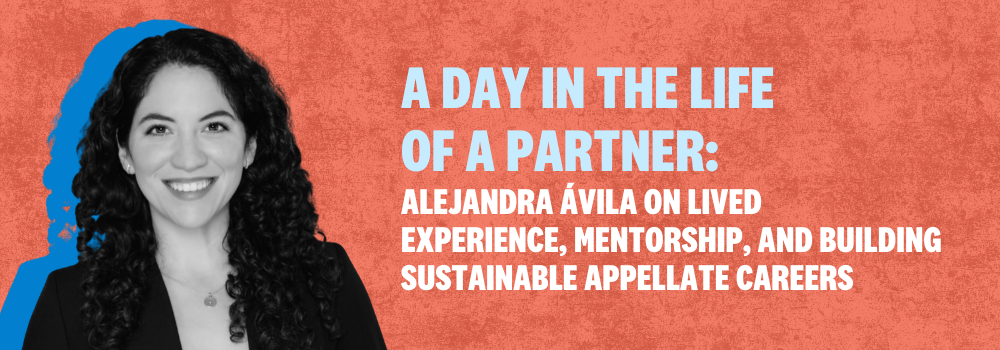
A Day in the Life of a Partner: Alejandra Ávila on Lived Experience, Mentorship, and Building Sustainable Appellate Careers
This Women's History Month, we're sharing insights from Alejandra Ávila, a partner at Kellogg, Hansen, Todd, Figel, and Frederick, PLLC, on mentorship, representation, and what it takes to build sustainable careers in appellate practice. Her path demonstrates what becomes possible when emerging leaders have access to workplaces and communities that create space for both excellence and their full humanity.
Walk us through what a typical day or week looks like.
Fortunately for me, there is no “typical” day or week. I work at a litigation boutique, where I manage all kinds of cases. One day I’m writing a Supreme Court brief about bankruptcy, the next day I’m defending a deposition in an antitrust case, and the next day I’m working with an expert on a question of foreign law. I chose this job because it keeps me on my toes, every day is different, and I am always learning something new. Like many lawyers, however, I am a creature of habit, and I do religiously enjoy my cup of coffee in the morning!
What is your approach to managing multiple cases or projects at once?
The best managers I had as a young lawyer trusted me to do the work while providing the right amount of mentoring and guidance to allow me to grow and improve. I try to emulate that balanced approach now, entrusting associates and staff with substantive responsibilities and empowering them with the tools they need to handle their matters. I strongly believe that cultivating young talent is an investment that pays off because it allows upper management to delegate efficiently, increases morale across the team, and improves work product overall. Most important of all: it’s good practice to be kind to your colleagues.

What skills have had the greatest impact on your success as a lawyer—and how did you go about developing or strengthening those skills along the way?
Strong writing skills are imperative as a litigator. We persuade through our writing, and legal writing is a unique skill. Since early on in my career, I invested in this skill through rigorous law school courses, writing-intensive internships, and clerkships.
If you could go back to when you first started as an associate, what advice would you give yourself?
I would remind myself to foster my relationships with mentors. Working hard pays off, but having strong mentors who have your back is critical, particularly in the appellate space where competition is fierce. I am where I am today because good mentors along the way believed in me and took steps to see me succeed. It is important to find those people and cultivate those relationships.
As a woman of color in private practice, what does it mean to bring your full identity into your work? And why does representation in this space matter?
I think representation is important in any workspace, but it is especially important in the legal profession. As lawyers, we have the peculiar responsibility of helping enforce the rule of law, and we wield tremendous power and influence in the justice system. Having colleagues who bring a diverse array of life experiences to the table yields richer and better ideas, which is good for clients, good for firms, and good for the profession. Recruiting and retaining talented attorneys from all walks of life also combats stereotypes and ensures that the most qualified lawyers see a path to success in private practice regardless of their background.
Can you share an example of how diverse lived experiences have made a tangible difference in your workplace?
Two years before I was promoted to partner at my firm, my mom was diagnosed with stage four breast cancer. During that time, I served as her primary caregiver, traveling with her to appointments, translating for her, and handling all her medical bills and insurance issues. Women, particularly women of color, disproportionately serve as caregivers to family members, so this was a common lived experience to many people in my life. At work, I was fortunate to be at a place where people understood that I needed to prioritize my family and who gave me the tools I needed to do that despite the pressures of the job. I took the medical leave I needed and was promoted after I came back. I think that type of representation matters—it allows associates to see a sustainable future in a place where people’s humanity is respected, and where hard work and the most challenging facets of life can co-exist.
Building Pathways Forward
Alejandra's path is a reminder that representation in the justice system requires creating workplaces where talented lawyers from all backgrounds can build sustainable careers. Her experience as a caregiver reflects what many women of color face while building legal careers, and her story shows what becomes possible when workplaces make space for these realities. When mentorship, hard work, and supportive firm culture come together, the entire field grows stronger.
At The Appellate Project, we work to ensure emerging appellate leaders have access to the mentorship and community that proved essential for Alejandra. By connecting talented lawyers with a support system that believes in them and strengthening community among those navigating appellate careers, we're creating sustainable pathways for the next generation.
This Women's History Month, we celebrate professionals like Alejandra whose careers show that representation means more than diversifying who gets hired—it means building workplaces where everyone can thrive.
